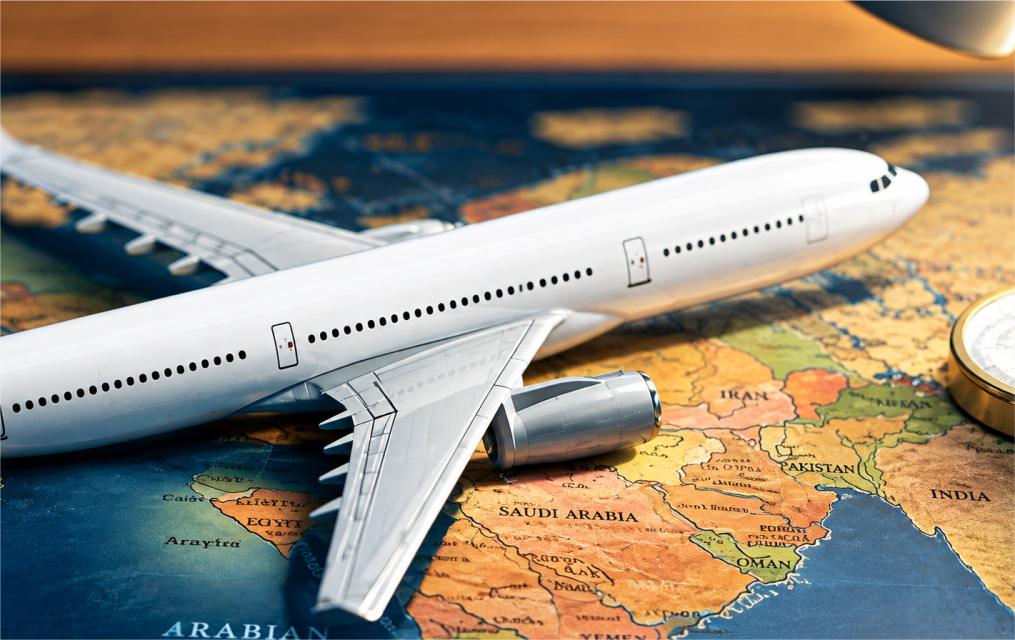
India does not have a shortage of dreams. It has a shortage of pilots, and the road to the cockpit is longer than most families expect. Every year thousands of young Indians look up at a passing aircraft and decide to fly. Very few of them know how many pilots the country needs, how many flying schools exist, how long training really takes, or what they must check before they pay a single rupee.
This blog answers all of that, in order. We start with the big picture, then look at aviation growth, the flying training system and licence numbers, and we finish with the new DGCA guidelines that every trainee should read before signing.
India is going through one of the fastest growth phases in its civil aviation history. Rising incomes, better regional connectivity, new airports and aggressive fleet expansion have made it one of the world’s fastest-growing aviation markets. Indian airlines have placed orders for more than 1,700 aircraft. The Ministry of Civil Aviation estimates that India may need around 30,000 to 34,000 additional pilots over the next 10 to 15 years, which is roughly 2,500 to 3,400 pilots every year.
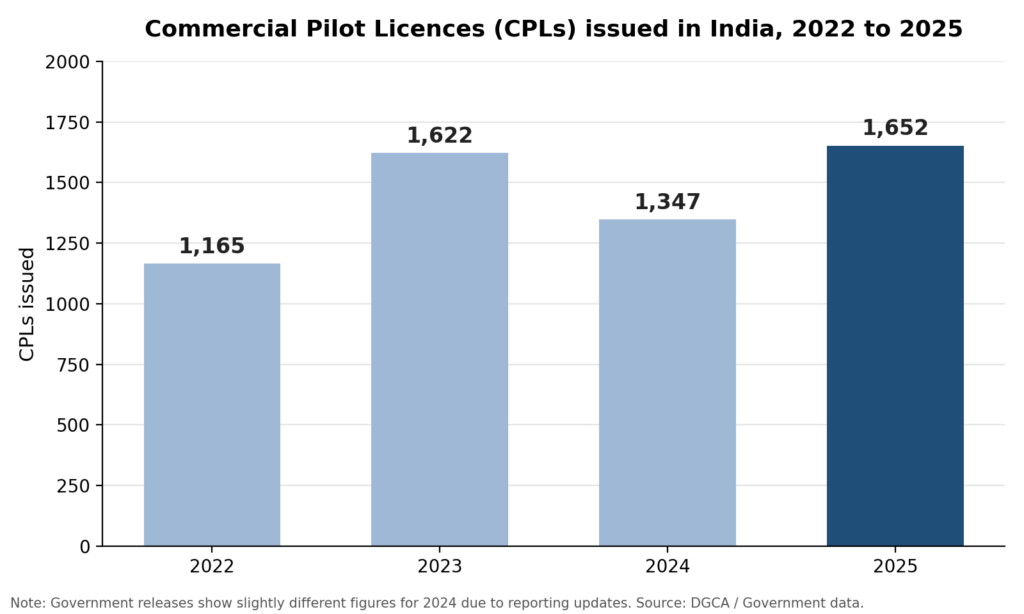
The training side is growing too, but at a slower pace. As of early 2026, India had about 41 DGCA-approved Flying Training Organisations (FTOs) working from 63 flying bases, with around 385 trainer aircraft. More than 2,300 Student Pilot Licences (SPLs) are issued every year. DGCA issued 1,347 Commercial Pilot Licences (CPLs) in 2024 and 1,652 in 2025, the highest annual output India has seen. Still, that is below the long-term requirement, and training takes 18 to 30 months, so the gap cannot be closed overnight.
This is not simply a shortage of flying schools. Aircraft availability, instructor shortage, maintenance downtime, weather, airspace congestion, financing and DGCA exam timelines all decide how fast a student becomes a pilot. That is also why many Indian students train abroad and then convert their licence.
Keep these numbers in mind, because the rest of this blog builds on them, part by part. Five things to remember:
Not long ago, air travel in India was meant for a small section of society. Today it is part of everyday transport and economic life. The change began with liberalisation in the early 1990s. In 1994, the Air Corporations Act was repealed and private airlines were allowed. Between 2003 and 2005, low-cost carriers made flying affordable for first-time flyers. From 2006, airports were modernised through public-private partnerships. In 2016, the UDAN scheme began connecting smaller cities and underserved airports. And in 2023 to 2025, Indian airlines placed record aircraft orders.
According to IATA, India is expected to become the third-largest air passenger market in the world during this decade. The country already has more than 150 operational airports. Passenger traffic recovered quickly after COVID-19, helped by rising incomes, business travel, tourism and competitive fares.
The fleet expansion is the most visible sign. Air India Group, IndiGo, Akasa Air, Air India Express and SpiceJet (through fleet renewal) are all adding aircraft. Every aircraft needs multiple crews, because airlines must cover daily flying, leave reserves, training needs and duty-time limits. Pilot demand also comes from retirements, regional aviation, cargo, business aviation and helicopter operations.
But pilots cannot be produced overnight. Training needs aircraft, qualified instructors, approved organisations, simulators, airspace, fuel, maintenance, regulatory oversight and a lot of practical flying hours. If training capacity does not grow along with airline fleets, the result can be pilot shortages, more dependence on foreign-trained pilots, rising training costs and recruitment delays. Which brings us to the schools themselves.
Every airline pilot starts at a Flying Training Organisation. Training in India is governed by the Aircraft Act, 1934, the Aircraft Rules, 1937 and the Civil Aviation Requirements (CARs) issued by DGCA. DGCA approves FTOs, standardises syllabi, licenses pilots and instructors, approves training aircraft, conducts examinations and audits FTOs regularly.
There are three broad types of training organisations. Government flying clubs once led the field and many still operate, but with small fleets. Private FTOs now dominate, with modern aircraft, maintenance facilities, simulators and structured programmes. Airline cadet academies are growing too, where airlines partner with selected FTOs to give graduates a clear path to employment.
The journey itself follows a fixed order: Class XII with Physics and Mathematics, DGCA Class I and Class II medical, Student Pilot Licence, Private Pilot Licence, Commercial Pilot Licence, Instrument Rating, Multi-Engine Rating, Type Rating, airline recruitment, line training, First Officer and finally Captain.
Most FTOs train on single-engine aircraft like the Cessna 172 and Diamond DA40, and multi-engine training is done on aircraft like the Diamond DA42 and Piper Seneca. Glass-cockpit aircraft have improved training because students get used to avionics similar to those in airliners.
The number of aircraft does not tell you the real capacity. What matters is how well each aircraft is used, which depends on serviceability, maintenance, weather, fuel, air traffic and instructor availability. Good FTOs run multiple flying shifts a day. And instructors are the most valuable people in any school. India faces periodic instructor shortages because many instructors move to airlines for better pay.
Aircraft teach students how to fly, but instructors teach them how to think. Simulators help students practise instrument procedures, emergencies and Crew Resource Management at lower cost and with more safety, but real flying remains essential for handling skills. Challenges remain: limited training airports, congested airspace, monsoon and summer heat, maintenance delays, examiner shortage and licensing timelines. On the bright side, airline cadet programmes, advanced simulators, digital learning and new FTO projects are all on the rise.
If you want to judge a training system, look at how many licences it actually delivers. A CPL needs about 200 hours of flying experience for aeroplanes, DGCA theory exams, RTR(A), a valid Class I Medical and a skill test with an authorised examiner, along with cross-country, night, instrument and solo flying.
The numbers show clear growth: 1,165 CPLs in 2022, 1,622 in 2023, 1,347 in 2024 and 1,652 in 2025. Government releases show slightly different figures for 2024 because of updates in reporting and the timing of parliamentary replies, but the upward trend is consistent.
Why are CPLs fewer than SPLs? First, training takes 18 to 30 months, so SPLs issued this year become CPLs in later years. Second, not everyone finishes. Students can struggle with exams in Air Navigation, Meteorology, Air Regulations and Technical subjects. Some need extra flying hours. A medical issue can stop training. Money problems and operational delays also play a part, and high training costs, limited education loans and rising fuel costs make it harder.
A realistic timeline looks like this: ground school 3 to 6 months, flight training 12 to 18 months, and skill test and licensing 2 to 6 months, with DGCA exams running alongside.
Many CPLs each year go to candidates trained abroad, in South Africa, the United States, Australia, New Zealand and Canada, followed by DGCA licence conversion. The reasons are better weather, higher aircraft utilisation, more instructors, faster completion and larger fleets.
CPL numbers alone can mislead. Better measures are average training duration, student completion rate, aircraft utilisation, instructor-to-student ratio and the CPL employment rate. The real question is not how many CPLs are issued, but whether that number can support India’s future airline fleet. Every licence represents years of disciplined study and rigorous flying, and the challenge is to keep that journey efficient without lowering safety standards.
After all these numbers, one question matters most to you as a trainee. When you walk into one of these schools, what protects you? On 5 October 2026, DGCA issued a public notice on Flying Training Circular 02 of 2026, which sets guidelines for agreements between FTOs and trainees. The aim is transparency, fair practices and accountability, with greater clarity and protection for trainees and their parents or guardians.
Before enrolment, DGCA wants you to be clearly informed about:
The guidelines also provide for progressive payment of fees, which broadly means payment in stages, transparency in any change of fees or essential terms during training, fair treatment of unutilised fees, and proper arrangements for transferring training records if training stops or cannot continue with the same FTO. FTOs must keep a grievance mechanism and make sure money matters do not compromise the quality, continuity or safe conduct of training.
Now connect this with what you just read. Training can run for 18 to 30 months, and delays from aircraft maintenance, weather or instructor shortage are common. So ask before you pay: if training takes longer, does the fee change? If I stop midway, what happens to unused fees? If I move to another FTO, who releases my records?
DGCA advises trainees and parents to read the agreement and fee and refund conditions carefully, get a mutually signed copy, keep payment receipts and training records, and ask for written clarification on anything unclear. Also check that your FTO is on the DGCA-approved list available on the DGCA website. If you plan to train abroad, ask the same questions at that school too.
One limit to understand: these guidelines are not meant to regulate every aspect of the private contract between an FTO and a trainee, and DGCA does not intend to act as a judge in purely commercial disputes. Your best protection is a clear, written, signed agreement.
India will need thousands of pilots, and the sky has room for every one of them. But the road to the cockpit is long and costly, and it should never begin with a signature you did not understand. Pilots are trained never to take off without a checklist. Make your training agreement the first item of yours.
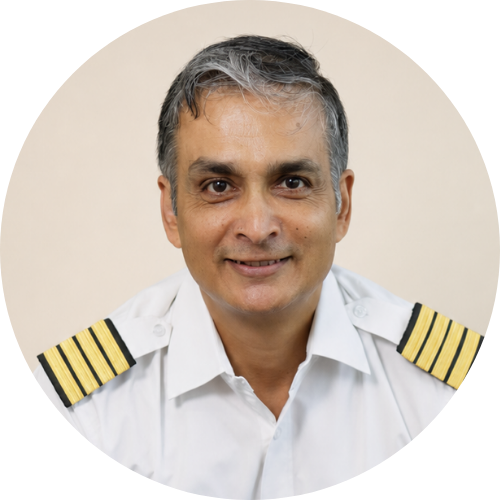
Choosing the right aviation career requires more than passion—it requires the right guidance.

© 2026 Captain Sudhanshu Dubey | All Rights Reserved.